
A few years back, I sat across from a client who could hold it together at work, smile through small talk, and even make it to the grocery store until she got home. The minute her door closed, the panic would start: chest tightness, racing thoughts, the familiar spiral. The only thing that reliably interrupted that loop was her old orange tabby, who would trot over, press against her legs, and insist (with cat-level stubbornness) on being held. She described it plainly: He brings me back into my body. That’s a useful way to understand emotional support pets, often called emotional support animals (ESAs).
Their value isn’t mystical, and it isn’t just pets are nice. For many people dealing with anxiety, depression, PTSD, grief, or chronic stress, an emotional support pet becomes a steady, living anchor one that can complement therapy, medication, and lifestyle changes. Below are the most meaningful, research-backed and real-world benefits of emotional support pets, along with some limitations and ethical considerations that deserve more attention than they typically get.
Nervous system regulation you can actually feel
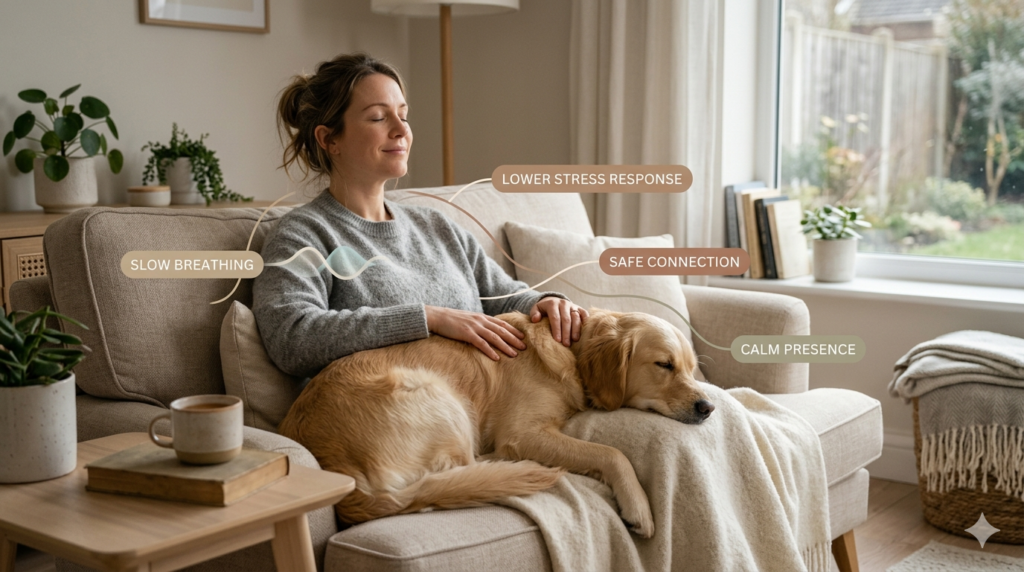
One of the biggest benefits of emotional support pets is how they help people regulate stress in the moment. Anyone who has absentmindedly petted a dog while talking through something difficult has felt a version of this: your breathing slows, your shoulders drop a fraction, and the intensity eases. There’s good reason for that. Physical touch and rhythmic interaction stroking fur, listening to purring, walking with a dog can reduce physiological arousal. Studies around human–animal interaction often point to changes in stress-related markers (like cortisol) and increases in bonding hormones (like oxytocin), though the exact effects vary by person and setting.
The practical takeaway: an ESA can function like a bridge back to baseline when your body is stuck in fight-or-flight. It doesn’t solve the root cause, but it can create enough calm to use coping skills that do.
Real-life example: A young veteran I spoke with described nighttime as his hardest stretch. He didn’t need his dog to perform a task like a trained service animal; he needed the simple certainty of a warm body at the foot of the bed and the routine of a final walk before sleep. The dog’s presence helped shorten his time to fall asleep and reduced hypervigilant checking.
Structure and routine when motivation disappears
Depression, burnout, and chronic anxiety often destroy routine first. Meals get weird. Sleep shifts. The days blur. Emotional support pets create gentle, unavoidable structure: feeding times, walks, grooming, litter box cleaning, vet visits. This is one of the least glamorous benefits of emotional support animals and one of the most powerful. Routine isn’t just about productivity; it’s mental health scaffolding.
When people tell me, I can’t take care of myself, I often hear a different truth underneath: I can’t find a reason to start. An ESA can be that reason on the hardest days, the small push that gets someone out of bed and into daylight.
Reduced loneliness and more social connection (without forcing it)
Loneliness doesn’t always look like being alone. Plenty of people feel isolated inside relationships, workplaces, or crowded cities. Emotional support pets offer companionship that is steady, nonjudgmental, and importantly nonverbal. There’s also a secondary effect: pets can make safe, low-stakes social contact more likely. Dog owners chat at the park.
Neighbors recognize each other on walks. Even a cat can create connection through online communities or simple conversations with friends (How’s your little menace doing?). For someone with social anxiety, these micro-interactions matter. They’re exposure, but softer less performative.
Emotional grounding during flashbacks, panic, or spirals
It’s important to be clear: emotional support animals are not the same as psychiatric service dogs. ESAs typically aren’t trained to perform specific tasks like interrupting self-harm, retrieving medication, or doing deep pressure therapy on cue. But even without specialized training, many pets naturally do things that help during distress: they nudge, they stay close, they seek contact, they respond to changes in tone and posture.
The benefit here is grounding a shift from catastrophic thinking back to immediate sensory reality. A client once described it as borrowing my dog’s calm. That’s not scientific language, but it’s accurate in spirit.
Better adherence to treatment plans (because life feels more doable)

When someone is struggling, even basic treatment steps keeping therapy appointments, taking medication consistently, reducing alcohol, exercising can feel pointless. ESAs don’t magically improve compliance, but they can make the day-to-day more manageable, which indirectly supports treatment.
I’ve also seen pets act as a protective factor during relapse-prone periods: the person still shows up for the walk, still maintains a small routine, still has a reason to come home. This isn’t a substitute for professional care, but it can be a meaningful support alongside it.
Housing stability in a world where pets are often excluded
A huge practical benefit of emotional support pets in the U.S. is housing accommodation. Under the Fair Housing Act (FHA), many tenants can request a reasonable accommodation to live with an ESA, even in buildings with “no pets” policies, as long as the request meets the legal criteria. This matters because stable housing is mental health care just the unglamorous kind. People who would otherwise have to choose between a supportive animal and a lease sometimes get to keep both.
A caution, though: landlords can request reliable documentation, and accommodations aren’t unlimited. If an animal poses a direct threat or causes significant property damage, that changes the situation. (Also, those instant ESA certification websites are often predatory and can create legal trouble for tenants who rely on them.)
A healthier relationship with responsibility and self-worth
This one is subtle, and it doesn’t get talked about enough. Caring for an animal can rebuild self-trust. When someone has been through trauma, job loss, divorce, addiction recovery, or long-term illness, they often carry a story that they’re unreliable or too broken.
Successfully caring for a pet showing up every day chips away at that story. It’s not that responsibility fixes mental health. It’s that a manageable, meaningful responsibility can restore identity.
Limitations and ethical considerations (because ESAs aren’t a trend)
The benefits of emotional support animals are real but so are the downsides when ESAs are treated like a loophole.
- Not every person is in a place to care for a pet: If someone is frequently hospitalized, financially unstable, or living in unsafe housing, adding an animal can increase stress.
- Not every animal is suited to the role: Temperament matters. An anxious dog paired with an anxious person can become a feedback loop of stress.
- ESAs are not service animals: They generally do not have public-access rights in restaurants, stores, or workplaces unless a separate policy applies.
- Air travel rules changed: In the U.S., airlines are no longer required to treat ESAs as service animals (policy shifts followed U.S. DOT changes in recent years). Some airlines allow pets in cabin under standard pet policies, but that’s different from ESA accommodation.
- Animal welfare matters: An ESA is not a tool. If a person is using the animal in ways that cause distress dragging a fearful pet into overstimulating environments, for example that’s not support. That’s harm.
When emotional support pets work well, it’s because the relationship is mutually safe and stable, and the animal’s needs are treated as seriously as the human’s.
Choosing an emotional support pet: what tends to matter most
People often fixate on species dog vs. cat vs. rabbit. In practice, success depends more on:
- Lifestyle fit: energy level, grooming needs, noise tolerance, work schedule
- Temperament: calm, resilient, people-friendly (or at least stable at home)
- Financial readiness: food, preventive care, emergency vet fund
- Backup care: who helps if you get sick, travel, or hit a rough patch
A well-matched emotional support pet feels like support, not another crisis to manage.
FAQs
Q: Are emotional support animals the same as service animals?
A: No. Service animals are trained to perform specific tasks related to a disability; ESAs provide comfort through companionship and don’t have the same public-access rights.
Q: What mental health conditions can an emotional support pet help with?
A: They’re commonly helpful for anxiety, depression, PTSD, panic disorder, grief, and chronic stress, though results vary by person.
Q: Do emotional support pets have housing rights?
A: In the U.S., many do under the Fair Housing Act, if the person qualifies and proper documentation is provided. Rules and exceptions apply.
Q: Can landlords deny an emotional support animal?
A: Sometimes. If the animal poses a direct threat, causes substantial damage, or the request is not legally valid, a landlord may deny it.
Q: Do ESAs help with panic attacks?
A: They can, by grounding and calming the nervous system, but they aren’t a guaranteed solution and don’t replace therapy or medical care.
Q: Is an ESA letter the same as an online certificate?
A: No. Be cautious: many certification sites are scams. What matters is legitimate documentation consistent with applicable laws and clinical standards.