
I still remember the night my Labrador, Barnaby, decided that a porcupine was a friend rather than a foe. It was 11 PM, the local vet was closed, and I was staring at a dog who was pawing at his face, whining, and swelling up fast. My heart was hammering against my ribs so hard I thought he could hear it. In that moment, I realized that love isn’t enough. You need knowledge.
Pet emergencies don’t wait for business hours. They happen on holidays, during road trips, and in the middle of the night. While nothing replaces professional veterinary care, knowing basic pet first aid can stabilize your animal long enough to get them to an emergency vet. It’s the difference between panic and purpose.
The Calm Before the Storm

Here’s the hardest truth I’ve learned in years of fostering and owning dogs: your pet feeds off your energy. If you’re hysterical, they become terrified, which can raise their heart rate and worsen bleeding or shock. The first step in animal emergency care isn’t touching the wound; it’s taking a deep breath.
I keep a printed sheet of emergency numbers taped to the inside of my cabinet. It includes my regular vet, the nearest 24-hour clinic, and the ASPCA Poison Control Center. When you’re scrambling in the dark, you don’t want to be Googling open vet near me.
Building a Real-World Pet First Aid Kit
You can buy pre-made kits, but honestly, most are filled with fluff. I prefer building my own. I keep one in the car and one in the kitchen. Here’s what actually matters:
- Gauze and Vet Wrap: Self-adhering wrap is gold. It sticks to itself, not the fur.
- Saline Solution: For flushing debris out of eyes or wounds.
- Digital Thermometer: Rectal is standard for pets. Know their normal baseline (usually between 101 and 102.5°F).
- Tweezers & Scissors: blunt-ended scissors to cut matted fur or gauze safely.
- Muzzle: This is critical. Even the sweetest dog may bite when in pain. If you don’t have one, a strip of gauze can work in a pinch, but never muzzle a vomiting dog or one struggling to breathe.
- Hydrogen Peroxide (3%): Only use this to induce vomiting if explicitly told to do so by a vet or poison control. Otherwise, it’s for cleaning equipment, not wounds.
- Styptic Powder: Great for broken nails.
Handling Common Crises
Every situation is unique, but a few scenarios come up repeatedly.
Bleeding and Wounds
If your dog cuts a paw on glass or gets into a fight, apply direct pressure. I use a clean gauze pad and hold it firmly for at least three minutes without peeking. Peeking disrupts the clotting process. If blood soaks through, layer more gauze on top; don’t remove the original pad. Tourniquets are risky and should only be used on limbs as a last resort for life-threatening arterial bleeding.
Choking
If your pet is coughing forcefully, let them be. Coughing is good; it means air is moving. If they are gagging silently, pawing at their mouth, or their gums are turning blue, you have an obstruction. For smaller dogs, you can try the Heimlich maneuver by wrapping your arms around their waist and thrusting upward. For larger dogs, lay them on their side and push firmly on the abdomen behind the ribs. Check the mouth carefully, but beware of reflex bites.
Heatstroke
Summer pavement is hotter than you think. If your dog is panting excessively, drooling thick saliva, or seems wobbly, move them to shade immediately. Use cool (not ice cold) water to wet their paws and belly. Ice can constrict blood vessels and trap heat. Offer small amounts of water. Heatstroke in pets can cause organ failure quickly, so even if they seem to recover, see a vet.
Poisoning
This is where people make the most mistakes. Chocolate, xylitol (in gum), grapes, and lilies (for cats) are common toxins. Do not induce vomiting unless instructed. Some substances, like bleach or petroleum products, cause more damage coming back up. Call Poison Control immediately. They can tell you if you need to rush to the clinic or monitor at home.
The CPR Conversation
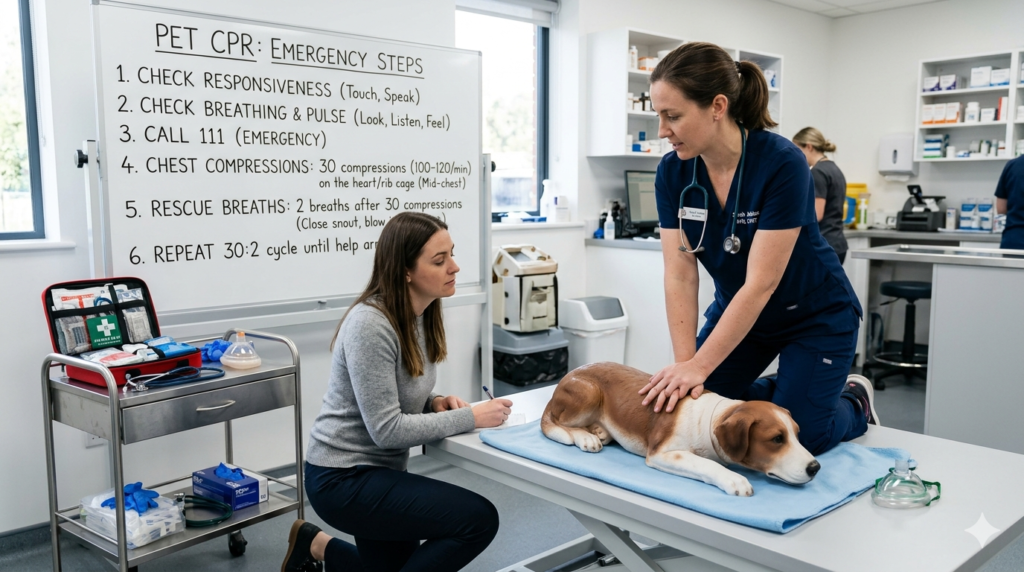
I’ve taken a dog CPR course, and I recommend every owner do the same. Reading about it isn’t enough; you need muscle memory. Generally, it involves compressions on the widest part of the chest and rescue breathing through the nose. However, CPR is physically exhausting and emotionally draining. It’s also not always successful. It’s a last-ditch effort to buy time until you reach professional help.
Knowing Your Limits
I need to be clear about something: I am not a veterinarian. This guide is based on personal experience and certified first aid training, but it is not medical advice. Pet first aid is about stabilization, not cure.
There’s an ethical line here. Trying to play doctor can cost your pet their life. I once saw a owner try to splint a broken leg with a magazine and tape so tightly it cut off circulation. By the time they reached the vet, the tissue damage was severe. If something looks serious a deep gash, difficulty breathing, inability to stand, or seizures skip the home treatment and drive.
Trust your gut. If your pet is acting off, they usually are. Animals hide pain instinctively. By the time symptoms are obvious, the issue is often advanced.
Final Thoughts
Preparing for an emergency doesn’t mean you’re expecting the worst; it means you’re ready to handle it if it comes. Keep your kit stocked, check expiration dates on meds, and make sure everyone in the house knows where the kit is.
That night with Barnaby? We got the quills out, kept him calm, and drove an hour to the nearest open clinic. He needed antibiotics and pain meds, but because we stayed calm and managed the immediate shock, he recovered fully. Preparation gave us that chance.
FAQs
Q: How often should I check my pet first aid kit?
A: Check it every six months. Replace used items, check expiration dates on medications, and ensure batteries in thermometers work.
Q: Can I use human painkillers like Ibuprofen for my dog?
A: No. Many human medications, including Ibuprofen and Acetaminophen, are toxic to pets. Never administer medication without vet approval.
Q: What is the number for Pet Poison Control?
A: In the US, the ASPCA Animal Poison Control Center is (888) 426-4435. There is usually a consultation fee, but it’s worth it.
Q: Should I induce vomiting if my dog eats something bad?
A: Only if instructed by a professional. Inducing vomiting can be dangerous if the item is sharp or corrosive.
Q: How do I transport an injured pet safely?
A: Use a board or stiff cardboard as a stretcher for large dogs to keep the spine aligned. For cats or small dogs, a carrier with plenty of ventilation is best.