
The airport lobby is always a study in controlled chaos, but nothing quite matches the spike in adrenaline you feel when standing in the check-in line with a pet carrier in hand. I have been on both sides of that counter as a seasoned traveler navigating the labyrinth of international pet relocation and as an advisor helping frantic pet parents decode the ever-shifting maze of airline pet policies. If there is one universal truth in the aviation world, it is this: no two airlines treat pets exactly the same way.
What works beautifully on a domestic Southwest flight can result in a heartbreaking denial of boarding at a Delta or Lufthansa gate. To safely and successfully fly with your dog or cat, you have to look past the marketing copy and understand the cold, hard operational realities of airline pet travel. Let’s break down exactly how airline pet policies work, what the fine print actually means, and how to prepare your furry companion for the journey.
The Three Ways Pets Fly: Understanding the Categories
When you book travel for a pet, they will fall into one of three operational categories. Knowing which one your pet fits into is the foundation of your planning.
1. In-Cabin (Carry-On)
This is the gold standard of pet travel. Your pet stays in an approved carrier, tucked safely under the seat in front of you for the duration of the flight.
- Who qualifies: Typically, only small dogs and cats.
- The catch: The combined weight of your pet and the carrier usually cannot exceed 15 to 20 pounds (though a few European carriers allow up to 22 pounds). Furthermore, the carrier must fit within strict under-seat dimensions, which vary not just by airline, but by aircraft model.
- Typical Cost: $95 to $150 each way domestically; higher for international routes.
2. Checked Baggage (The Hold)
In this scenario, your pet travels in a pressurized, temperature-controlled compartment of the plane. You check them in at the passenger ticket counter, and they travel on the same aircraft as you.
- The catch: This option has become increasingly rare. Due to safety concerns, extreme weather disruptions, and staffing shortages, major US carriers like Delta, United, and American have largely eliminated or severely restricted checked baggage options for pets, often reserving them exclusively for active-duty military families on PCS orders.
3. Manifest Cargo
If your pet is too large for the cabin and cannot travel as checked baggage, they must travel via the airline’s cargo division.
- Who qualifies: Large dogs, exotic pets, and animals traveling solo.
- How it works: You drop off and pick up your pet at a dedicated cargo facility, often located on the perimeter of the airport, rather than the main passenger terminal.
- The catch: It is incredibly expensive often costing upwards of $1,000 to $3,000 depending on the crate size and destination and requires navigating complex logistical hoops.
Navigating the Fine Print: The Crucial “Gotchas”
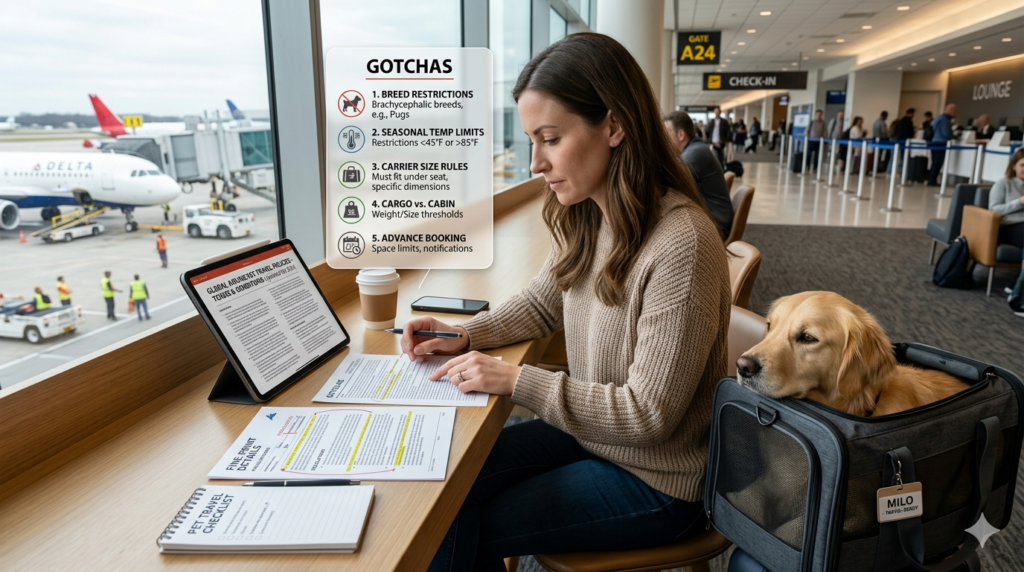
Even if you find an airline that accepts your pet, several hidden hurdles can ground your travel plans before they even begin.
The “Turn Around” Rule
If you are flying with an in-cabin pet, gate agents are trained to look for one specific behavior: your pet must be able to stand up, turn around, and lie down naturally inside the carrier. If your dog’s back touches the top of the carrier when standing, or if they look cramped, a gate agent has the absolute authority to deny boarding.
I once witnessed a traveler attempt to board a flight with a beautiful, leggy Italian Greyhound. The dog weighed only 14 pounds—well under the weight limit—but because of its long legs, it looked like a folded accordion inside the bag. The gate agent, adhering to safety protocols, refused to let them board. It was a painful, expensive lesson in checking height, not just weight.
The Brachycephalic (Flat-Faced) Ban
If you own a Pug, French Bulldog, Boston Terrier, Shih Tzu, or Persian cat, your options for cargo or checked baggage travel are virtually nonexistent. Because of their shortened airways, flat-faced breeds are highly susceptible to respiratory distress and heatstroke under stress or in stuffy environments.
Almost all major global airlines have outright banned brachycephalic breeds from traveling in the cargo hold. If you have a flat-faced pet, they must travel in the cabin with you, or you must seek alternative ground-transportation methods.
Weather and Temperature Restrictions
For pets traveling in the hold or cargo, airlines enforce strict extreme weather policies. If the forecast temperature at your departure, layover, or arrival airport is below 45°F (7.2°C) or above 85°F (29.4°C) at the time of travel, your pet will not be allowed on the plane.
While this rule exists entirely to protect your animal’s life, it makes summer travel across places like Phoenix, Dallas, or Miami highly unpredictable. A sudden midday delay can push temperatures past the limit, leaving you stranded at the gate while your pet is taken off the flight manifest.
The Service Animal vs. Emotional Support Animal (ESA) Divide
In recent years, the legal landscape of flying with animals underwent a massive shift. In January 2021, the US Department of Transportation (DOT) updated its regulations, ruling that airlines are no longer required to recognize Emotional Support Animals (ESAs) as service animals. Today, ESAs are treated as standard pets. They must fit under the seat, abide by the same size and weight limits, and pay the standard pet cabin fee.
Only fully trained Service Dogs (specifically trained to perform tasks for a person with a disability) are permitted to fly in the cabin outside of a carrier, free of charge. If you are traveling with a legitimate service dog, you must fill out the official DOT Service Animal Air Transportation Form at least 48 hours prior to departure, certifying your dog’s training, behavior, and health.
Preparing for the Flight: A Practical Checklist
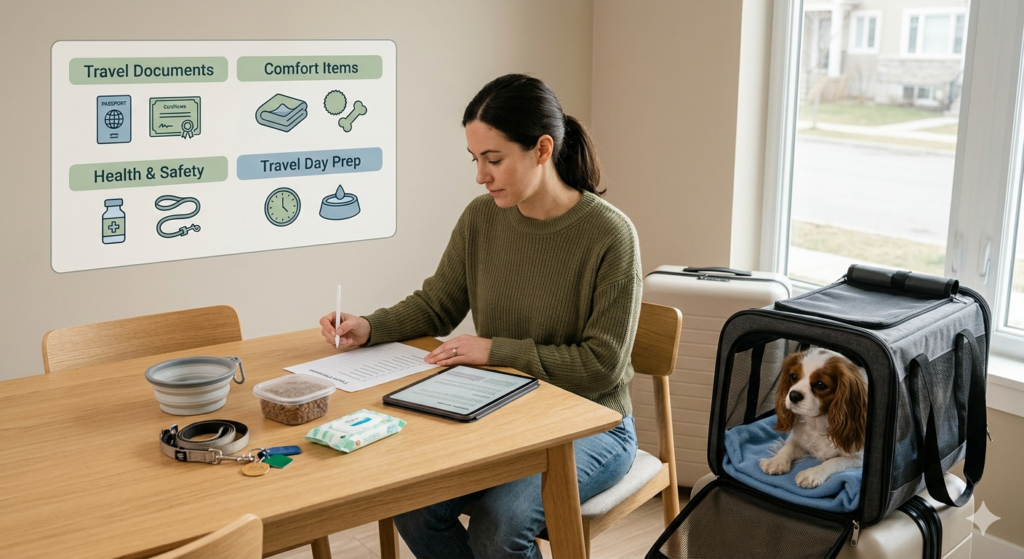
Success in pet travel is 90% preparation. If you are planning a trip, use this timeline to ensure you don’t miss a critical step:
- Acclimate the Crate Early: Do not buy a carrier the night before a flight. Buy it weeks in advance. Leave it open in your living room, put treats inside, and let your pet sleep in it. Your pet should view the carrier as a safe, cozy den, not a mobile prison.
- Book the Pet Space Immediately: Airlines limit the number of in-cabin pets allowed on any single flight (often just 4 to 6 pets per flight). Never book your ticket without calling the airline first or using their online booking tool to confirm that there is still a pet slot available on your specific flights.
- The Vet Visit: Most airlines require a Health Certificate issued by a licensed veterinarian within 10 days of travel. If you are traveling internationally, this process becomes exponentially more complex, often requiring USDA endorsement, rabies titer tests, and microchipping that must be executed in a very specific chronological order.
- Ditch the Sedatives (Unless Advised): It is tempting to want to sedate a nervous pet, but the American Veterinary Medical Association (AVMA) strongly discourages sedating animals traveling in the air. Sedatives affect a pet’s natural ability to balance and can cause dangerous cardiovascular and respiratory drops at high altitudes. Opt for natural calming pheromone sprays (like Feliway or Adaptil) instead.
Ethical Considerations: Should Your Pet Fly?
As someone who loves animals, I always advise pet owners to ask themselves a hard question: Is this trip for me, or is it for my pet? If you are moving across the country or relocating internationally, flying your pet is a necessity. But if you are going on a one-week vacation, subjecting a large dog to the stress of a cargo hold or even a small dog to the sensory overload of a crowded cabin is often unfair to the animal. Consider the stress levels, the age of your pet, and whether a trusted pet sitter or boarding facility at home might actually be the kinder choice.
FAQs
Q: Can I take my dog out of the carrier during the flight if they start crying?
A: Officially, no. Airline policies require pets to remain fully zipped inside their carriers under the seat for the entire duration of the flight. Doing so can result in a warning from flight attendants or being barred from future travel on that airline.
Q: Do airlines provide food and water for pets in cargo?
A: You are required to attach two empty dishes (one for food, one for water) to the inside of the cargo crate, along with a small bag of food taped to the outside. Airline personnel will replenish water during layovers, but pets are generally not fed during flights to prevent choking and motion sickness.
Q: What is the best soft-sided carrier for in-cabin travel?
A: The Sherpa Deluxe carrier is widely regarded as the industry standard. It features a spring-wire frame that allows the rear end of the bag to compress slightly to conform to varying under-seat heights without collapsing on your pet.
Q: Can I fly internationally with a puppy or kitten?
A: Most airlines require pets to be at least 8 to 16 weeks old to travel domestically. For international travel, pets often must be at least 12 to 16 weeks old because they require a rabies vaccine (which cannot be administered to very young animals) followed by a mandatory waiting period before border crossing.