
There comes a moment with every new puppy when the house stops feeling like a quiet home and starts feeling like a small animal shelter. Shoes get chewed. Curtains get nudged. That quiet moment after they fall asleep turns into a 2 a.m. wake-up call you didn’t sign up for. Crate training isn’t a magic fix but after a few weeks of consistent, calm application, it becomes the tool that turns chaos into routine, fear into security, and a stranger’s puppy into a dog you can actually live with.
Over the past several years, I’ve brought home five different puppies Labrador retrievers, a mini-schnauzer, a border collie mix and each time the crate process looked the same on the surface but required tiny adjustments based on personality, breed drive, and household rhythm.
What follows is the approach that has consistently worked: no tricks, no force, just a pattern that lets the puppy feel safe and learn boundaries.
Choose the right crate (and avoid the “decorative box” trap)
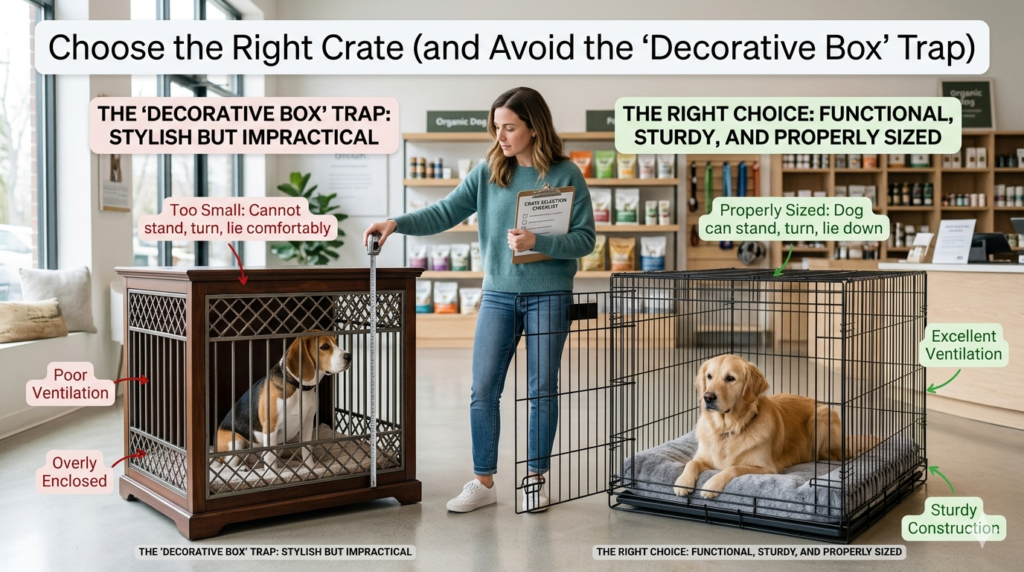
The first mistake people make is picking a crate based on looks rather than function.
- Size matters. The puppy should be able to stand up, turn around, and lie down comfortably with at least a few inches of wiggle room. If you buy a crate now for an 8-week-old puppy, by 6 months they’ll be cramming themselves into a corner or stretching so far they can’t settle. Measure against expected adult size not current size.
- Open-top vs. closed. An open-top crate (like a wire kennel) works best for the early phases because you can see their body language and intervene if they panic. Once they’re comfortable, a door-closed session for night time or travel is fine but only after they associate the enclosed space with safety, not confinement.
- Location matters. Place the crate in a high-traffic area not the basement or a closed room. Puppies thrive on auditory security: the sound of your voice, the TV at low volume, the hum of daily life. If the crate is in a quiet corner, the puppy will interpret it as danger zone.
Real example:
My border collie mix (let’s call her Luna) refused to settle in a crate placed in the hallway. Once I moved it just inside the kitchen next to where I was cooking and talking on the phone she started using it as her quiet office. Within a week she would curl up and fall asleep the moment she entered.
Make the crate a positive place before you ask anything of it
This is the most critical phase. If the crate becomes associated with frustration first (e.g., I got shut in), all future training collapses.
Step-by-step:
- Leave the door open 24/7.
Put the puppy’s favorite things inside: a soft blanket (not a blanket from the bed that builds bed-sharing expectations), a chew appropriate for the age (PUPPY-LEVEL teeth not adult tough toys), and a small amount of kibble scattered on the floor of the crate.
They should choose to go in because it feels like a reward, not a command. - Short, happy visits.
Every few minutes, go over to the crate, speak in a calm, neutral tone (Good crate!), drop a treat inside, and step back.
After a day or two, the puppy will start wandering in on their own usually after sniffing the food.
Do not force them in. If they resist, close the door for 2–3 seconds after they are already inside, then immediately open it again. The goal is association: “inside = something good happens.” - Let them set the pace.
Some puppies take 24 hours. Some take 4 days. One of my Lab puppies used to bounce in, shake himself like a wet dog, and immediately bolt out again that’s normal exploratory behavior. As long as they eventually settle for any amount of time (even 30 seconds), you’re on track.
Observation tip:
If the puppy whines or paws at the door constantly for more than 10–15 minutes, they are not not ready they are under stimulated. Add more interaction before the crate time: a short play session, a sniff walk, or a training game. A tired or mentally engaged puppy settles faster.
Gradual time increments the “layered sleep” method
Once the puppy voluntarily settles for 5–10 minutes, you start building duration slowly.
Rushing here creates anxiety; going too slow turns the process into a drag.
How it works (real schedule, not theory):
| Day | Crate time (door closed) | What to watch for |
|---|---|---|
| 1–2 | 2–3 minutes | No whining after 60 sec. Open door, reward with treat outside. |
| 3–4 | 4–5 minutes | If whining starts >90 sec, end early. |
| 5–7 | 6–8 minutes | They should fall asleep part of the time — that’s the goal. |
| 8–10 | 10–12 minutes | By now, night time can use the full closed session. |
Key rule:
If the puppy cries, you do not wait them out for 20 minutes. You end the session after 1–2 minutes of consistent whining and try again later. Long, drawn-out crying teaches if I scream long enough, I get released and that becomes a nightly battle.
Case study:
My mini-schnauzer, Theo, had a high alert system. The first night I closed the door for 5 minutes, he emitted a single sharp bark and that was it he had decided the crate was a watch tower.
Instead of forcing duration, I turned crate time into guard duty. I gave him a small job toy (a soft ball with a treat compartment) and rewarded him for staying in his spot. Within 3 days, 5-minute sessions became 15 without a sound.
Night time the moment most people get it wrong
Night time is not the time to test how long the puppy can hold it. It’s the time to confirm the crate is a safe sleep space.
Practical setup:
- Feed the final meal 30–40 minutes before crate time.
An empty stomach at midnight = panic. - Use the same crate routine every night:
- Short play/sniff break (to burn energy).
- Quick potty break outside.
- Into the crate, door closes, you speak softly, then you leave the room no lingering, no I’ll check in 10 seconds.
- If they whine:
First 2–3 minutes: stay near the door (no eye contact, no talking).
After 3–5 minutes of quiet: you may peek. If they are calm, give a treat outside the crate and close the door again for another 2 minutes.
If they keep crying after 10 minutes: end the session early. They need more daytime elimination practice, not a sleep test.
Real outcome:
After three nights of early endings with my first Lab, the crying dropped by 80%. The message shifted from I hate being here” to I know you leave when it’s quiet.
Daytime crate use when (and when not) to use it
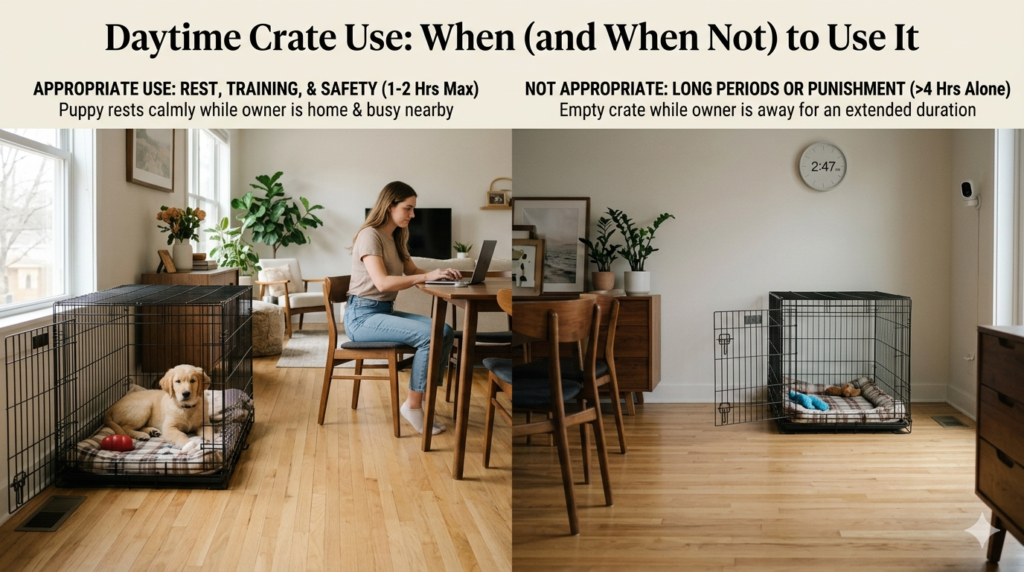
During the day, the crate is not a jail. It’s a break room.
- Use it when:
You need a 5-minute break (bathroom, phone call).
The puppy is overstimulated by people coming in and out.
You’re preparing for a longer outing (pre-walk quiet time). - Don’t use it when:
They are still learning basic commands (they need freedom to practice sit, stay, etc.).
It becomes a default for every 2 minutes of chaos (they’ll associate the crate with every time I get rowdy I get locked).
A good rule of thumb:
If the puppy is calm and content when you open the crate during the day, they are ready for a short closed session.
If they bolt out screaming, they are not ready keep the door open and add more mental engagement first.
Common pitfalls (and the subtle fixes)
Pitfall 1 They need to learn they can’t escape.
False. Crates work because of association, not confinement. Forcing a puppy into a small space until they give up creates resistance.
Fix: Always let them leave when they choose. Never use the crate as a punishment.
Pitfall 2 Inconsistent people.
If one person treats the crate as time out and another treats it as nap time, the puppy gets confused.
Fix: One household rule. If the crate is positive for you, it must be positive for everyone.
Pitfall 3 Overfeeding before crate time.
A full tummy at night = stomach discomfort + whining.
Fix: Last meal 30–40 minutes prior. A few kibble crater treats inside the crate are fine but not a big snack.
Pitfall 4 Ignoring breed drive.
High-energy breeds (border collies, Australian shepherds) need a job inside the crate.
Fix: Use a slow-treat puzzle or a quiet command before closing the door. Give them a mental task so they aren’t staring at the wall.
When it’s working the signs
You’ll know crate training has stuck when:
- The puppy voluntarily goes in to avoid chaos (e.g., when guests arrive).
- They fall asleep inside within 5–10 minutes, every day.
- Night time whining is brief (under 2 minutes) or absent.
- They eat, drink, and potty normally when the door is open showing no fear of the space.
At that point, the crate has shifted from a training tool to a comfort object much like a child’s small bedroom.
FAQs
Q: How long does it take for a puppy to adjust to the crate?
A: Most puppies settle within 7–14 days if the process is consistent. Some high-drive breeds take 3–4 weeks, but the key is short, positive increments rather than speed.
Q: Is it okay if my puppy cries at first?
A: A short period of whining (under 5 minutes) is normal as they adjust. Long, repetitive crying means they feel trapped end the session early and revisit shorter durations later.
Q: Should I leave the crate door open all the time?
A: Initially, yes. The door should stay open until the puppy chooses to enter and stays for at least 2–3 minutes. Only then do you start closing it for short timed sessions.
Q: Can I use the crate for punishment?
A: No. Using the crate as a time out erodes trust. The crate must always be linked with something positive food, rest, quiet not with anger or removal of attention.
Q: My puppy keeps trying to chew the crate bars. What do I do?
A: Wire crates can feel like teething toys. Add a soft blanket inside so the bars aren’t the focal point. You can also cover the top bars with a cloth (secured so it doesn’t come loose) to reduce encouragement.