
If you’ve ever stood in your kitchen at 7:15 a.m., coffee in one hand, leash in the other, while your dog treats “sit” like a vague suggestion, you’re not alone. I’ve spent the better part of fifteen years working with dogs and their humans first as a volunteer at a city animal shelter, then as a professional trainer running group classes in community centers, vet offices, and even a few apartment-complex courtyards where the biggest distraction was the smell of someone’s breakfast burrito drifting down from a third-floor balcony.
And here’s the truth I’ve learned the hard way: dog obedience training doesn’t have to be complicated, expensive, or emotionally exhausting. It does have to be consistent, humane, and built around how dogs actually learn not how we wish they learned.
Start With the Relationship, Not the Rules
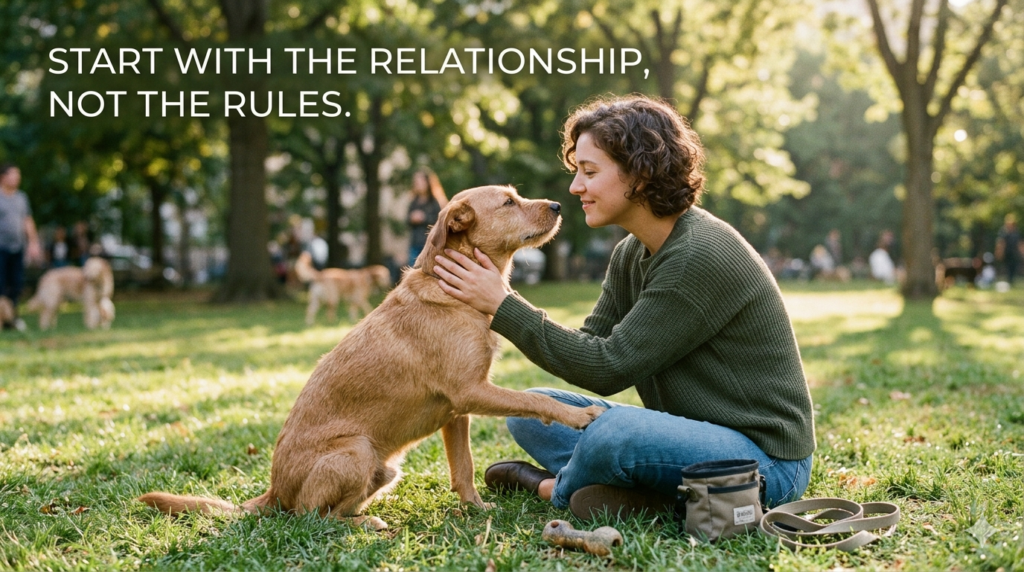
Too many people begin obedience training by trying to install commands like software updates. Sit. Stay. Come. Heel. Good dog. But dogs don’t learn in a vacuum. They learn in a relationship. I once worked with a family who adopted a two-year-old rescue Labrador named Milo. They were frustrated because Milo ignored every cue unless food was involved. When I watched them interact at home, the pattern was obvious: they mostly spoke to Milo to correct him Off the couch, Stop barking, Don’t jump. Milo wasn’t being stubborn. He was being trained, accidentally, to associate human voices with stress.
The first week of our plan didn’t include a single formal obedience command. We focused on attention: rewarding Milo for checking in with his people, offering calm body language, and earning access to the good stuff (walks, play, sniffing time). Within ten days, sit and come got dramatically easier because Milo was already tuned in.
The Three Pillars of Easy Obedience Training
If you want a simple framework that actually works in the real world busy schedules, loud neighborhoods, modern distractions like delivery trucks and doorbell cameras build your training around these three pillars:
- Clear cues, tiny steps. Dogs thrive on clarity. Don’t say Come here, buddy, please, come on, ugh, COME! Pick one word (come), say it once, and make it worthwhile. Break behaviors into small approximations. If you’re teaching stay, start with one second, one foot away, then gradually build duration, distance, and distractions.
- Reinforcement that matches the dog. Food is often the fastest teaching tool, especially early on. But reinforcement isn’t only treats. For some dogs, it’s a tug toy, a chance to sniff a patch of grass, permission to greet a friendly person, or a quick game of fetch. The key is that the reward must be valuable in that moment. A biscuit means nothing to a dog who’s fixated on a squirrel.
- Real-life proofing. Training in the living room is cute. Training at the park, near traffic, with kids running past, with the neighbor’s cat on the fence that’s obedience. I remember a client with a high-energy Border Collie mix named Juniper who could heel perfectly in an empty parking lot. The first time we tried it outside a busy café, Juniper morphed into a furry kite. We didn’t scold her. We went back to basics: one successful step at a time, lots of treats, and shorter sessions.
Common Mistakes That Make Training Harder Than It Needs to Be
In my experience, most obedience struggles come from a handful of predictable mistakes:
- Too-long training sessions. Five minutes, twice a day, beats a single exhausting 45-minute drill.
- Inconsistency across family members. If one person allows the dog on the bed and another doesn’t, the dog learns that rules are optional.
- Punishment-based methods. Harsh corrections can suppress behavior temporarily, but they often create fear, conflict, or worse aggression. Modern, evidence-based training prioritizes humane reinforcement and management (like using a leash indoors at first) over intimidation.
- Expecting adult reliability from a puppy brain. Puppies are adorable chaos machines. They can learn fast, but they also need naps, putty breaks, and realistic expectations.
Ethical, Practical, and Current Considerations
Today’s dog owners are navigating a different world than even a decade ago. More people live in apartments, work hybrid schedules, and rely on dog walkers, daycare, and pet cameras. That means training plans need to be portable and teach cues that transfer across handlers. It also means we have a responsibility to prevent nuisance behaviors excessive barking, lunging, door-darting that can strain neighbor relations and even put dogs at risk of rehoming.
And let’s be honest about limitations: some dogs come with serious fear, reactivity, or trauma histories. If your dog growls, snaps, or shows escalating aggression, don’t tough it out alone. A qualified, force-free professional can help you build safety and progress without gambling with bites.
A Simple Weekly Plan You Can Start Tomorrow
- Monday/Wednesday/Friday: 5 minutes each of sit, down, and stay (starting easy, then adding distractions).
- Tuesday/Thursday: 5 minutes of come games in the house or a fenced yard.
- Daily: Reward voluntary check-ins (Look at me!) a few times throughout the day.
- Weekend: One 10-minute real-world walk practice: stop at corners, reward calm, practice one cue at a time.
Dog obedience training made easy isn’t a fantasy. It’s the result of patience, good timing, humane methods, and a willingness to meet your dog where they are muddy paws, squirrel obsession, selective hearing, and all.
FAQs
Q: How long does it take to train a dog to be obedient?
A: It depends on the dog, the behavior, and your consistency, but many basic cues can become reliable in a few weeks with short daily practice.
Q: Should I use treats forever?
A: No. Treats are training fuel. Over time you fade them out and replace them with praise, play, sniff breaks, and real-life rewards.
Q: What’s the most important command to teach first?
A: A reliable recall (come) and a strong leave it are often the most life-saving and relationship-building cues.
Q: Is obedience training different for rescue dogs?
A: Sometimes. Rescues may need extra time to decompress and build trust, but they can absolutely learn with gentle, patient methods.
Q: When should I hire a professional trainer?
A: If you’re seeing fear, reactivity, aggression, or you feel stuck despite consistent practice, a qualified force-free trainer or veterinary behaviorist is worth the investment.