
Leash training sounds simple until you’re the one being dragged down the sidewalk by a thrilled Labrador or standing frozen while your rescue dog refuses to move an inch. I’ve worked with enough dogs and their equally overwhelmed owners to know that leash walking is rarely just about the leash. It’s about communication, timing, trust, routine, and a little patience on the human side.
The good news is that most dogs can learn to walk calmly on a leash. Not perfectly, not all the time, and not overnight but well enough that walks become enjoyable instead of stressful. If you’re looking for practical leash training tips for dogs, here’s what tends to make the biggest difference.
Start With the Right Expectations
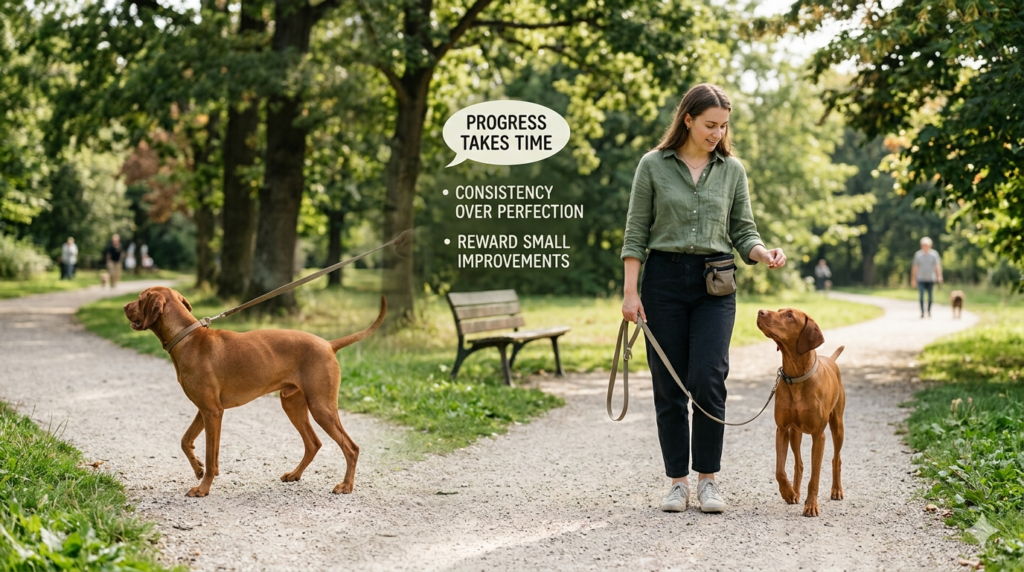
One of the most common mistakes people make is expecting a dog to understand leash manners the moment the collar goes on. Puppies bite the leash, adolescent dogs lunge toward every bird and bicycle, and adult rescues may have no positive leash experience at all. Loose-leash walking is a skill. Like any skill, it has to be taught in small steps.
A young puppy may only manage a few seconds of focus. A high-energy dog might need movement breaks before training begins. A nervous dog may first need to feel safe simply wearing a harness indoors. Progress is rarely linear, and that’s normal.
Choose Equipment That Helps, Not Hurts
Good leash training starts with humane, well-fitted gear. In most cases, I recommend:
- A standard 4- to 6-foot leash
- A properly fitted harness or flat collar
- Small, high-value treats
- A treat pouch for easy timing
For dogs that pull hard, a front-clip harness can offer better control without causing pain. It doesn’t fix pulling by itself, but it can make training safer and more manageable. A regular flat collar is fine for some dogs, though not ideal for forceful pullers, especially small breeds or dogs prone to throat issues. I generally advise against retractable leashes for training. They often teach the dog that pulling creates more freedom, which is the exact opposite of loose-leash walking.
Teach Leash Skills Indoors First
This is the part many people skip, and it matters. Your dog is far more likely to succeed in the living room than on a busy street with squirrels, smells, and passing trucks. Start in a low-distraction space. Put the leash on, stand still, and reward your dog for being near you. Then take one or two steps. If your dog follows without tension, mark the behavior with a cheerful yes or click and give a treat.
You’re teaching a simple idea: staying close to you is rewarding. Keep sessions short five minutes is plenty at first. End while the dog is still engaged. That small success builds momentum.
Reward Position, Not Just Compliance
A lot of owners accidentally reward the wrong thing. For example, the dog pulls ahead, then comes back, and gets a treat. That can work in some training setups, but if your timing is off, your dog may think pulling was part of the reward chain. Try to reward when the leash is loose and your dog is where you want them next to you or within a comfortable range. If your goal is a calm walk, reinforce calm walking.
This doesn’t mean your dog has to march in perfect heel position like a competition dog. For everyday pet owners, loose leash is enough. The leash should hang slack most of the time, with your dog checking in and moving with you.
Stop When the Pulling Starts
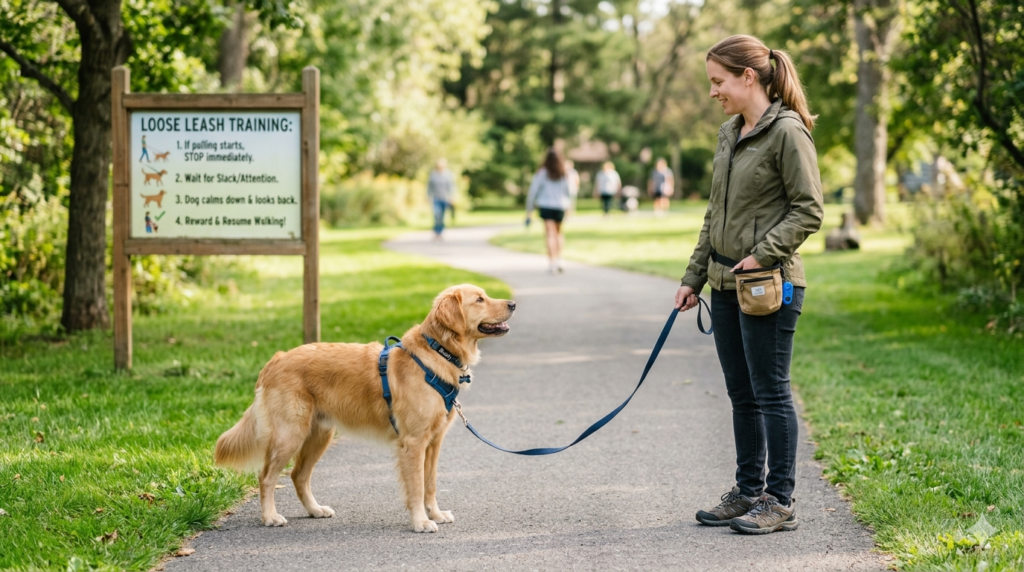
One of the most reliable leash training tips is also the least glamorous: if the dog pulls, stop moving. Dogs pull because pulling works. It gets them to the grass, the tree, the smell, the person, the interesting thing. If pulling consistently moves them forward, they’ll keep doing it. The moment the leash goes tight, stop. Wait.
When your dog turns back, softens the tension, or takes a step toward you, move again. This teaches that a loose leash makes the walk continue. Is it slow? Very. Sometimes painfully so in the beginning. But it’s clear, fair, and effective when used consistently.
Change Direction to Keep Attention
For dogs that forge ahead nonstop, changing direction can help. Walk one way, then calmly turn and go the other. When your dog catches up and walks with you, reward. This technique keeps your dog tuned in to your movement instead of assuming they can tow you around.
It also turns the walk into a shared activity rather than a tug-of-war. That said, don’t overdo sudden turns with fearful dogs. Sensitive dogs may find too much unpredictability stressful. In those cases, slower pacing and more reassurance work better.
Use Better Rewards Outdoors
Many dogs perform beautifully indoors and then forget everything outside. They’re not being stubborn. The outdoors is simply more stimulating. If your dog won’t take kibble outside, upgrade the pay. Soft treats, bits of chicken, cheese, or another safe high-value reward can help you compete with environmental distractions. For some dogs, sniffing itself is a reward. You can use that too.
A simple pattern works well:
- Dog walks nicely for a few steps
- You reward with a treat
- Then say, “Go sniff,” and let them investigate
This teaches that paying attention to you doesn’t ruin the fun it leads to it.
Practice Around Distractions Gradually
Don’t expect your dog to master leash walking at the farmer’s market if they can’t do it on your driveway. Gradual exposure matters.
Work through distractions in layers:
- Indoors
- Backyard or quiet sidewalk
- Calm neighborhood street
- Park at a distance
- Busier public spaces
If your dog is pulling, whining, barking, or unable to take treats, the environment may be too difficult. Create distance and lower the challenge. That’s not failure. It’s smart training.
Understand What Pulling Really Means
Not all pulling comes from excitement. Sometimes it comes from fear, frustration, or lack of exercise. I’ve seen dogs labeled “bad on leash” who were actually under-stimulated and bursting with energy. I’ve also seen dogs that lunged because they were anxious around other dogs and trying to create space.
Those situations need different solutions. An energetic dog may benefit from play or training games before a walk. A fearful or reactive dog may need behavior support beyond basic leash training. If your dog shows intense reactivity, panic, or aggression, it’s worth consulting a qualified force-free trainer or veterinary behavior professional.
Keep Sessions Short and Consistent
Leash training improves faster with frequent short practice than with one long frustrating walk every few days. Even ten focused minutes a day can create noticeable change over a couple of weeks.
Consistency matters more than intensity. If one family member allows pulling and another stops every time, progress will be slower. Everyone walking the dog should use roughly the same rules.
Don’t Rely on Corrections Alone
You can physically stop a dog from pulling with certain tools or methods, but that’s not the same as teaching them how to walk well. Good leash manners come from clarity and repetition, not just suppression.
Reward-based training tends to build more willing, relaxed behavior. It also strengthens the relationship, which is often the hidden win. A dog who checks in with you on walks is easier to guide through the world.
Final Thoughts
The best leash training tips for dogs are usually the simplest: start small, be consistent, reward what you want, and don’t rush the process. Some dogs learn fast. Others take weeks or months, especially if they’ve had a long history of pulling. That doesn’t mean you’re doing it wrong.
A successful walk doesn’t have to look perfect. If your dog is calmer than last week, recovers faster, and spends more time with a loose leash, that’s real progress. And in everyday life, progress is what makes walks enjoyable again.
FAQs
Q: How long does leash training take for a dog?
A: It depends on the dog’s age, history, and consistency of training. Some improve in days; others take several weeks or longer.
Q: What is the best age to start leash training?
A: You can start basic leash exposure and walking skills as early as puppyhood, once the puppy is comfortable and safe.
Q: Why does my dog pull so much on walks?
A: Pulling is often driven by excitement, habit, anxiety, or excess energy. The key is identifying the cause and training accordingly.
Q: Are harnesses better than collars for leash training?
A: For many dogs, yes. A well-fitted harness can be safer and more comfortable, especially for dogs that pull hard.
Q: Should I use a retractable leash for training?
A: Usually no. Retractable leashes often encourage pulling and make it harder to teach consistent leash manners.
Q: What if my dog is reactive on leash?
A: Basic leash training may not be enough. A qualified trainer or behavior professional can help with a safer, more tailored plan.