
I’ve lived with cats for over fifteen years, and I can tell you with certainty that the biggest misconception about feline behavior is that cats are untrainable. They’re not stubborn or aloof by nature they’re just motivated differently than dogs, and most people don’t understand the language they’re actually speaking. When I first brought home my rescue cat, Milo, he had a habit of knocking everything off countertops.
My vet suggested I was being too soft on him, my mom insisted he was just being a cat, and my neighbor swore by a spray bottle. None of those approaches worked. What finally clicked was understanding why he was doing it, and more importantly, understanding that cats aren’t being destructive out of spite. They’re problem-solving, exploring, and often seeking attention sometimes even the negative kind.
The Foundation: How Cats Actually Think
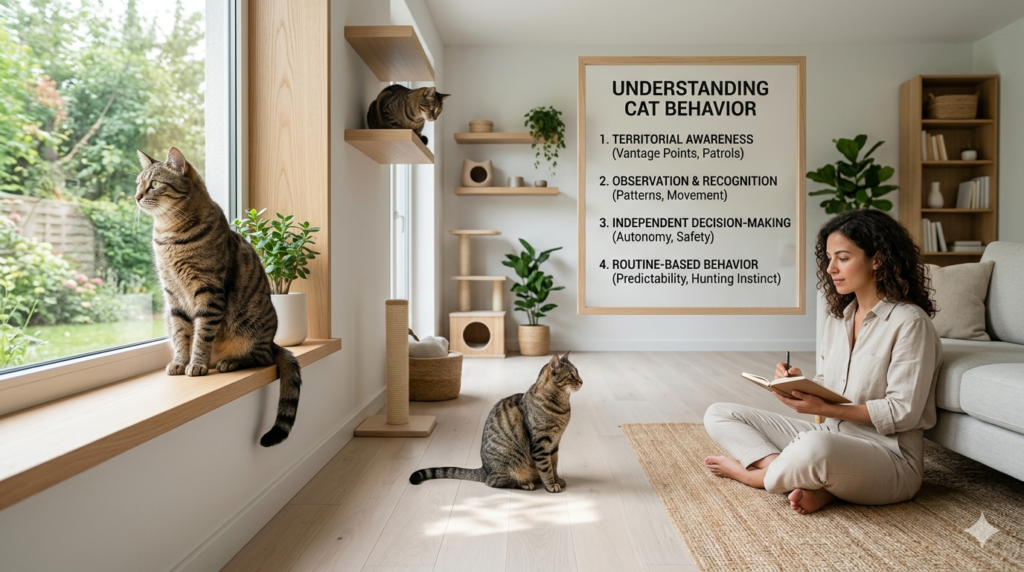
Before we talk about training, we need to understand feline cognition. Cats are independent creatures with their own cost-benefit analysis happening constantly. Unlike dogs, which evolved alongside humans for thousands of years and are hardwired to seek our approval, cats domesticated themselves relatively recently in evolutionary terms. They tolerate us because we provide food and shelter, but they’re not inherently motivated by pleasing us.
This doesn’t mean they don’t care about us. It means they care about themselves, which is actually useful information for training. Every behavior a cat performs or refuses to perform is based on what benefits them. Your cat isn’t ignoring your commands because they’re stubborn; they’re ignoring them because there’s nothing in it for them.
I learned this lesson the hard way when I tried traditional training with Milo. I’d call him, and he’d walk away. I thought he was being difficult. Actually, he was making a rational decision: whatever he was doing was more rewarding than coming to me. That’s not defiance that’s intelligence.
Motivation: The Real Currency in Cat Training
The breakthrough in my relationship with Milo came when I stopped trying to make him do things and started making it worth his while. Cats are motivated by four primary things: food (especially high-value treats), play, territory control, and social interaction. Some cats weight these differently. Milo is 80% food-motivated and 20% play-motivated. My friend’s cat, Luna, would rather have twenty minutes of interactive play than a gourmet treat.
High-value treats are your best tool here. I’m not talking about regular kibble. I mean the stuff cats go crazy for freeze-dried chicken, small pieces of cooked salmon, or commercial treats that smell intensely. The key is using these only during training sessions, which makes them special and valuable in your cat’s mind.
Start with short, frequent sessions. Three to five minutes, multiple times a day, is far more effective than one long session. Cats have shorter attention spans than dogs, but they also respond faster to training because each session feels fresh and novel to them.
Common Behaviors and Real Solutions
Litter Box Issues: This one deserves special attention because inappropriate elimination is the number-one reason people rehome cats. When a cat stops using the litter box, it’s almost never because they’re being spiteful. It’s medical (urinary tract infections, kidney disease) or environmental. I’ve seen this play out too many times: a cat stops using the box, the owner gets frustrated, and the cat ends up in a shelter. Always start with a vet visit to rule out medical issues.
If it’s behavioral, consider the box itself. Is it clean? Cats are fastidious creatures, and a litter box that you think is acceptable might be revolting to them. I switched to daily scooping and noticed an immediate improvement. Also, the cardinal rule: you need at least one box per cat, plus one extra. So two cats need three boxes. Sounds excessive, but it works.
Scratching and Destructive Behavior: Your cat isn’t trying to ruin your furniture. They’re marking territory, maintaining their claws, and getting physical exercise. Milo’s counter-surfing made sense once I realized he was seeking height, novelty, and my attention ideally all at once.
Instead of punishing, redirect. Set up attractive scratching posts and vertical spaces. Use catnip, silvervine, or honeysuckle to make them appealing. When your cat uses the post, reward them immediately. When you catch them on the furniture, don’t yell (this can create fear and anxiety). Simply interrupt and redirect to the post, then reward.
Aggression or Excessive Biting: This is often playfulness in disguise, especially with younger cats. I used to let Milo play-bite my hands until one day he actually hurt me. Then I realized I’d been inadvertently teaching him that my hands were toys. The solution was simple but required consistency: whenever teeth touched skin, play stopped immediately. No yelling, no punishment just complete withdrawal of attention. He learned within two weeks that biting = end of fun time.
For genuine aggression, consult a feline behaviorist. Aggression often stems from fear, pain, or early socialization issues, and it requires professional intervention.
The Role of Environment and Enrichment
Here’s something that took me years to understand: training isn’t separate from enrichment. A bored cat is an out-of-control cat. They’ll knock things off counters, attack your hands during sleep, and develop stress-related behaviors. Enrichment for cats looks like: puzzle feeders, window perches for bird-watching, climbing trees, toys that mimic hunting (feather wands are essential), and regular interactive play sessions. Rotating toys keeps them novel. I keep some toys in a closet and swap them out weekly; Milo reacts to new toys with the enthusiasm of a kid on Christmas morning.
Environmental setup also prevents problems before they start. If your cat jumps on counters, make counters less appealing and jumping-down spots more appealing. Aluminum foil is a texture cats generally dislike. Motion-activated air sprays provide an aversive (unpleasant) consequence without you being the bad guy. Your cat learns that counters are inherently unpleasant, not that you’re punishing them.
Training Specific Commands and Behaviors
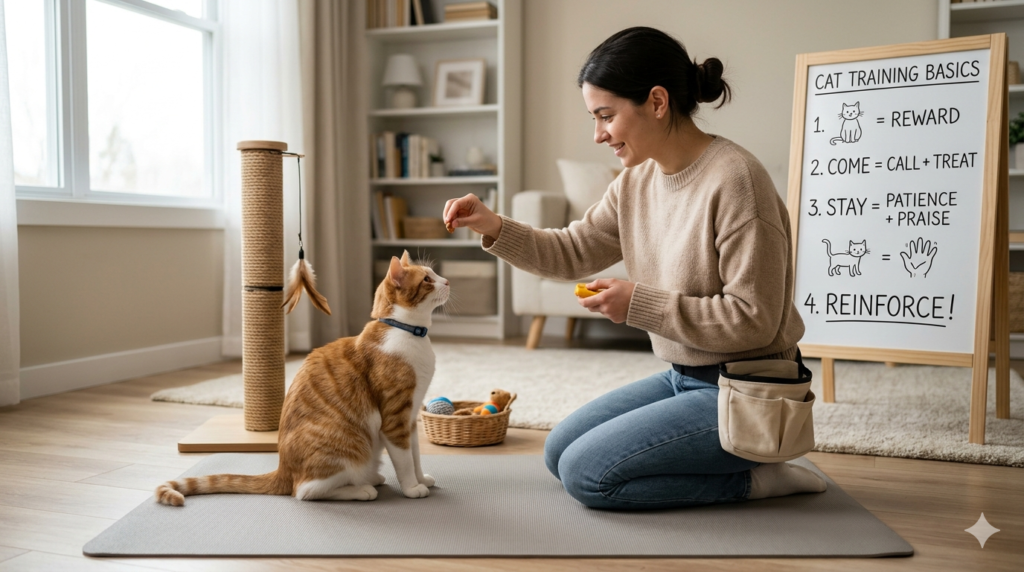
Yes, you can teach a cat to come, sit, or even walk on a leash. The method is identical to dog training but requires patience and realistic expectations. Your cat will do these things when motivated, not on command. I trained Milo to come by standing a few feet away with a treat, making a distinctive sound (I use a small clicker), and rewarding immediately when he approached.
Over weeks, I increased distance. He’s now reliable about coming when called if I have treats or if he’s in the mood. He’s not going to come when he’s chasing a moth; he’s a cat, not a golden retriever. Clicker training works beautifully with cats. Click the moment they do the desired behavior, then immediately give a reward. The click becomes a promise of a treat. This is more effective than praising and much more precise than punishment.
When to Call a Professional
If your cat has aggression issues, severe anxiety, or behavioral problems that aren’t responding to your efforts, consult a certified feline behaviorist. These professionals have specialized training and can often solve problems that seem unsolvable. A few sessions can literally change your relationship with your cat.
The Patience Principle
Training a cat requires accepting that they’re not mini-humans with fur. They have different priorities, different timelines, and different learning styles. You can’t force a cat to do anything, but you can make what you want them to do irresistible.
After fifteen years, the most important thing I’ve learned is this: training works best when it’s built on understanding. Understand why your cat does what they do, respect their nature, and build from there.
FAQs
Q: Can adult cats be trained?
A: Absolutely. Cats of any age can learn new behaviors. Older cats might take slightly longer, but they’re often more food-motivated and less easily distracted.
Q: How long does cat training take?
A: It varies by behavior and individual cat, but most basic behaviors show progress within two to four weeks of consistent, short sessions.
Q: Why doesn’t my cat respond to punishments?
A: Cats don’t connect punishment to behavior the way dogs do. Punishment creates fear and damage your relationship without changing behavior. Redirection and positive reinforcement are far more effective.
Q: Is it normal for a cat to ignore me during training?
A: Completely normal. If your cat isn’t interested, the reward isn’t valuable enough, you’re not using the right timing, or your cat is tired. Try again later with better rewards.